Meklabor – Raw Reeds // NMMREM XIII

Very black metal

Meklabor’s is yet another interesting artist from Russia who is also involved in the martial & dark folk projekt Ostov. He states himself that Meklabor is bagpipe music with hardware-made ambient, distorted drums and drones. Certainly a very unusual combo for a Russian artist who says to be inspired by slavonic folk traditions! Judging by this release the inspiration doesn’t stop in folk but goes deeper from folk straight into mystical terrains.

Meklabor’s Raw Reeds serves as an intro that could well be based on a sludge record. Based on this, it would be too easy to just entitle this record Meklabore. The second song Fields already proves this wrong with odd rhythm and a fine melody with a… Bagpipe? A definite !?! upon the first listen. The sounds aren’t top notch, for example the record would agree with a deeper and more organic bass sounds; somehow the sounds lack the final punch. The third, Bessarabaska continues the interesting experiment comprising an Alamaailman Vasarat-like klezmer-melody and applies a discobeat later. I still might not play this at a summer fest.

After three first tracks peak to a mildly annoying hippie-klezmerfest At The Gates, suddendly things go down the drain to dark ambient. Salamandra (Oil Edit) is mighty convincing dark ambient, but it is absolutely in the wrong place for the average Johns and Jacquelines. Bad trip, man. Multinational corporations in their oil-greed did this, man.

Salamandra does mark an imaginary B-side mark though, the following Thousand Years Beyond Kaspia continues the surprising industrial touch that Salamandra hints towards. Best of all Meklabor seems to be very natural with their industrial-side! The illusion breaks at 0.40 with, a very original, Meklaborish melody, but the industrial beat continues to throb on top of this mystic melody. After a month I somehow find myself thrilled by this melody though it didn’t impress me initially and it does repeat too much. I would have definitely lived without the 1.43 trance-interlude too

Haze is a bagpipe song and impresses less than its predecessors. Largely that is because its driven by another very Meklaborish melody, which you have just listened for 20 minutes; and for me this melody is the worst of the record. It does try and I feel the hook at 2.40 and 4.00 would be a memorable one, if only the melody wasn’t off my game. So unfortunately the album closes up in less memorable fashion than it started.

In the end Fields and Thousand Years Beyond Kaspia are the top cuts in the album, reclaiming the potential that other tracks only hint towards. The soundscapes in Raw Reeds are possibly more interesting than the melodies. There are lots of unique clever beat work and low-bass sections which throb in the back and may go unnoticed but still add in to the atmosphere. Also kudos to Meklabor for having the second edition of Salamandra as a clear bonus track.

Raw reeds encompasses a mystical atmosphere which adds to the value, it could be a swan song for a culture that never existed with its own glyphs, prophecies and gods. Music impresses and at the same time fails to capture its utmost potential. Still a very worthy release that surely people with an ear towards mystical ambiance and modern beats can appreciate!

7½/10

Free download: http://archive.org/details/siro318Meklabor-RawReeds

Avs_Silvester – Mansipal’s Heaven // NMMREM XII

Avs_silvester is a Russian artist with lots of interesting concepts for albums, for example the “Periodic Table of Sounds”. His new album or actually a compilation of old tracks is stated as Fusion, Progressive, ethno-rock with a very interesting concept.

“Mansipal – the historical name of the east Ural Mountains in the language of the native Finno-Ugric people of Mansi (Voguls).  Mansi World is divided into three parts – lower, middle and upper world. The heaven is also divided into three tiers, one of which goes after the death one of the five souls of man.

The album – a compilation of tracks from different years – sending you on a journey through the three parts of this world.”

Sounds just like my cup of tea, but surely a very tough concept to pull out as well. Not every Average Joe is the next Omar Rodriguez or John Lennon, but it certainly doesn’t stop some people from trying. And it certainly shouldn’t stop people from trying. In essence that is a good thing, but when they try to form up creations like professional composers; sometimes physically challenged babies like Mansipal’s Heaven come up. It is supposed to be Progressive ethno-rock. But it is not really progressive, it is random. It is pretty ethnic, but it is mostly not rock at all. It should be classified as experimental or improvisational guitar jam.

How many people really want to hear improvisational guitar jams of the greatest guitarists in the world? Hand to the heart, how many of you would like to hear an improvisational guitar jam of a mediocre layman guitarist with rather bad sounds? This is ultimately what Mansipal’s Heaven is. The guitar lines have a lot of glitches and mistakes. This could still be acceptable if the songs were good. You can hear there are compositions behind but mostly it seems the tracks are a mashup of certain guitar elements which are repeated in random places in – semi-similar to not similar at all – forms. In theory this could be a pretty ingenious way for making songs if those guitar elements just happened to not be mostly awkward and the placings had more style and pattern.

Many songs do have pleasant background ambience, for example Wind in the gorge, Music of silver and suitably named This strange autumn. Hell the chorus of This strange autumn is even catchy. Guitars are incoherent, but not as much as in most of the album. This marks the main problem and specialty of Avs Silvester. For example the title track seems to consist almost solely on guitar layers seemingly in not much contact with each other, drumming or keyboards. All forming different entities and playing on top of each other. When I release songs like this, I call them experimental or shitcore, not progressive. After an incoherent jamfest like Mansipal’s Heaven, This strange autumn sounds clear as a winter day when in earnest, it is a mess with a melody that when worked on could be very good.

The closest thing to a stable track is Mansipal’s heaven 2008 as it builds up nicely, in real standards mediocrely, the build up gets boring and the melodies never top the beginnings touch, but hey at least this time the track never went berserk! 2009 and 2010 versions of the same track encompass a less minimal approach with more guitar layers which ultimately means worse. Again the main riff really is not too bad (like in Fatal Chainsaw Massacre), if it just didn’t lead to a rather worthless improvisation after each repeat. Often less is more.

Most of the album feels like watching Journey Into Bliss on and on again, the shared sense of shame is always there. Maybe with some doses of mescaline this’d be a good trip with lots of laughing but with a clear mind it just boggling. The luck is, I’m a person having a liking in shitty and random music, so listening was in the end quite enjoyable, after getting through the disappointment of this not being a good album. But for any real music critic I can well believe this release effecting the tearing out of hair.

And hey, calling improvisational guitar jam progressive ethno-rock is just underrating the listener. If I’d known Mansipal’s Heaven to be a guitar jam I most likely wouldn’t have listened it at all – completely missing out the worst progressive rock album that I’ve ever heard! An eye opening release in a different way than expected.

Musicality: 2/10

Randomness: 9/10

Entertainment: 7/10

Free download: http://archive.org/details/siro484Avs_silvester-MansipalsHeaven

Yona-kit – Yona-kit LP

“A day later, Yasuko was shot out of the whale’s blowhole, landing safe on the deck of the yacht, still at sea. She spoke of bizzare goings on withing the whale’s gut…Progressive, avant-experimentalism, hardcore, ambience, metal, and a few less savory things all being digested together to form a racket the likes of which had never been heard. Days passed and Chiller Whale was nowhere to be found. The Skin Graft crew began to lose hope of ever seeing their pals again, until just moments before the search was to be called off, Chiller Whale appeared at the ship’s bow! He opened his mighty jaws to reveal the castaways, stronger than before, shoes shined and united under the moniker Yona-Kit (Jonah-Whale). They : stepped out and rejoined the Skin Graft crew. “I’ve got it all on tape!” exclaimed Steve. “


Math rock with a pinch of Japanese obscurity

Dirty, raw, psychedelic, odd and well, slightly annoying at times. Truly one of its kind. Yona-kit’s only LP is a real menace, the groove is on and the sounds are just right when you want your dose of lo-fi crunchiness. The tracks have a real energy and live feeling, but instruments also have their own space to operate and are visible parts of the entity. The image of the band is also stunning and the LP cover looks like it’s been ripped out from a cheap copy of Alejandro Jodorowsky’s or Terry Gilliam’s puppetshow rip-off movie. And that is just right!

Initially I came across this record searching for covers of an English child ballad Two Corbies (also covered by Sol Invictus); and Yona-Kits cover shone out by its sheer uniqueness.

The album boasts three clear hits with Franken-Bitch, Skeleton King and Two Corbies; i would also add the obscure (well everything else about this album is obscure too) instrumental Dancing Sumo Wrestlers near their rank. Hey, a song name like that alone is close to a classic!

The 23 minute anti-magnum opus Slice of Life is a very fitting way to end the album. After about 5 minutes the rest of the 18 minutes is a repeat of the same riff. Oh how I was disappointed at first listens that the blissfull jam just stalls its development. I later came to appreciate the feeling of stopping the album in the midst of a great riff!

Psycho Mum – Riff Rough // NMMREM XI

Psycho Mum, an artist I genuinely have no idea about and a musician of genres which I loathe (Rave, “ugh” / Disco, “UGHH!” / Break, “just add in core please”). Being the first experimental review for Narrow-Minded Metalhead, this was certainly a good shock factor to start :). Anyway, Psycho Mum is todays reviewed release; sponsored by http://www.random.org.

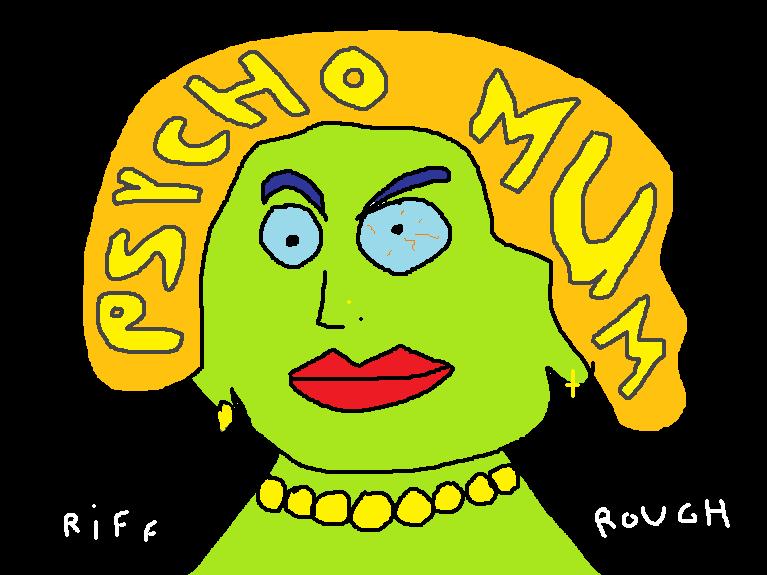
The cover of the album looks ugly and cheap. Looks like a 2 minute paint work. So it made me expect something intentionally shitty. However the title track Riff Rough turns out to be a surprisingly interesting abstract and psychedelic track with a lo-fi vibe. So lo-fi is where the cover art hints to? Makes some sense.

The song starts out slowly and progresses first to an odd (I like oddness) psychedelic beeping (I like psychedelia and beeping) noise (and most of all I like noise). This is soon layered with a psychedelic beat. This progress steadily with a cool surprising, though a bit cheap sounding effects, coming in here and there quite melodically.

The song grows up nicely, and after multiple listens the seemingly random breaks can better be appreciated as well. I’m sure this would work great with fitting visuals. Odd sounds popping in from here and there add more flavour.

In the 2nd track. The beginning beats underline my loath for rave, two different deep bass-driven beats which sound to belong to a club, which I would not attend without an excess amount of beer. The pussy-sounding voice saying “Satan” is quite funny and very random, but more interesting is the nearly random beeping. The track underlines why im not a terrific fan of rave music. It gets boring even though there is stuff happening and variation.

As a release one song and one remix of the same song is a bit too little, though I must say the remix doesn’t really sound like the original at all, which is a good thing especially as it seems disco and rave are fitted to the second track and the first compasses of psychedelia and break. I do not get a huge interest in repeating the tracks once I got done with the first crush.

Nothing mind-blowing here, but the release did rise my interest factor for a short while. Not an attention grabber after the first listens, but the first track does hold up listening well. The release could be interesting for you if the two previously mentioned big UGH’s are your cup of tea. For me, I rather stay on my normal tea and keep looking for the first rave song to dig.

5½/10

Free Download: http://www.archive.org/details/siro030PsychoMum-RiffRough

SDSA – Drug Life mixtape

They say that rock does not have danger anymore and they are right because most of what normal people label as rock is done by rich men in their 40-50’s or corporate money making machines. Back in the day the best selling rock was filled with real cocaine-flavoured fantasies. But now those same people are still making songs. Or those who were smart enough to survive it.

“I’m steady noddin’ out like I got the narcolepsy
girl I like you so I put the GHB up in your Pepsi”
– SDSA – Operation (Feat. Spunky Smith) (Prod. By FluiD)


They say that metal does not have danger anymore and again they are right. The 90’s church burnings and mainstream’s ideology of heavy metal being of satan is far out sight.

But we are only talking about mainstream. With a short dive underground you can easily find music where danger still lives. Take for example an Iraqese band Acrassicauda who played metal literally between bombings and in the fear of authorities finding out what they are doing and shooting them. So when Esa Holopainen of Amorphis (or any other renowed metal musician) tells that metal does not have danger anymore of course it is like they say…

Danger is definitely not out of underground music and that is why it is such a juicy goldmine to find real emotions of. And if there is a single album that has been the definition of danger lately it is SDSA’s brilliantly named “Drug Life”. And what the hell, the album is a free download from Bandcamp.

SDSA is short of Suicidally Depressed Substance Abusers but this is no emo-shit. Apparently most tracks are influenced by really fucked up real-life situations and that is why they don’t end up making tracks often.

Fuck, im talking about rock and metal, but the stuff that’s tweaked my built-in danger meter lately the most; is underground hip-hop from Detroit. I never knew I could like hip-hop quite this much, but I always knew there must be jewels like this somewhere. Stuff that is too raw to ever be in public attention. Stuff that doesn’t have much distinctively good beats so to fully appreciate you have to dig deep to the drug-infused lyrics and mean vocal lines.

This stuff is full of danger and disfigured streetviews. Listening them, you can really hear that things in Detroit are fucked up.

education is shit, you cant live in this country without staying lit
– SDSA – Operation

The beginning of Drug Life contains more humour and is more on the fun-loving side of abusing drugs and yourself. The middle part (Japan Remix (Feat. Katha Underground) (Prod. By De-Paul), Midnite Snack and Mos Cryptic is the weakest. However it does lead way to brilliantly gloomy last 30 minutes of the album which makes the album a tight entity.

Is this picture really from 2010 or the 80s’?

“now we’re all getting raped like the drunkard out of party
that smoked too much chronic and drank too much bacardi
but this type of rapist is being sponsored by our government
i feel like i’d be fake if i wasnt speaking on this shit
the way they keep cutting my grandfathers pension
makes me want to hang myself with my own fucking intestines”
– SDSA – Operation

Like I said they are not emo-shit; their lyrics are full of pitch-black humour and abusing people, or themselves. To close this review, here is one of the juiciest bits of the pitch-black-humour sort. In my minds eye I can see this scene in JAM.

“We’re in a parking lot and the visions all hasty –
if you think i’ll let her go then you must be crazy
i wasnt about to drop of and ask for a number
i tore off her clothes and we fucked in a dumpster

you can call it sin but i threw her in
she had leftover tacobells on her chin
and a banana peel upon a heel
saw some bloody puke so i didnt kneel
grabbed a garbage bag and i took a seat
pulled out my dick and fucked her feet

we got trashfucked girl knew how to suck
she never woke up you can call it luck
tried a dozen positions i loved her style
she was my centerfold and i was Jay Geils”
– SDSA – Crash The Club (Prod. by ProBangers.com)

Overall score: 9/10

Download the album for free from here: http://trashfuckrecords.bandcamp.com/album/drug-life

Playing with Nuns – 1805 // NMMREM X

God knows how manyth split of Playing with Nuns, 1805 is named after Mary Nuns, an infamous woman born in 1805 and also by one of the base books of nunnerism “The nuns of the desert, or, The woodland witches”, released in 1805. No really im just shitting you. The nuns of the desert is a rather hilarious title of a book anyway.

Playing With Nuns is a noise/experimental artist hailing from Argentina and like previously mentioned, he has made over a hundred splits, cd-r’s and webreleases in just a few years. Of these releases my favourites include 4-way split “Origami Chupacabras”, Cd-r “North Korea in 5 minutes” and another Cd-r “Horse surgery”. I’m actually shitting you again, I’ve never listened to any of these but you must agree that the names of the splits are entertaining.
Time for your own thoughts

Time for your own thoughts by maxon / HBC

by maxon / HBC
From this baseline I placed 1805 to my record player, alas an mp3 in foobar2000 audio player v.1.1.8, a basic drag and drop manouver in between the artists Plain Ride and PMMP. Head-on collision with a soundwave is the easiest description of the beginnings of the first track, “The consequences of a chain reaction”. Huge soundwave some harsh noise but overall a more pleasant sort; I find myself not getting petrified by it, no matter where I am. My most enjoyable moment with this release is 3 am at lan party, where it worked well as seclusing myself out of this world.

The consequences of a chain reaction has an almost metal interlude at 10:05 with lovely bass-soundwave bursting in. But then continues mostly the same except for some entertaining oddities, for example mechanics at 13.00 which; if made by the British Death Metal band Carcass; could be titled “Chainsaw & Circular Saw Macabration of Mutes”.

1805, the title track, is considerably more soft, mostly half-way gentle glitching harsh noise. The end of it advances to Rainbosws (name dropping an obscure artist you haven’t heard about) like glitching pleasant sound. Almost like water pouring outside and dribbling against the glasses. After two different tracks the fittingly named “One more to annoy you” closes the album like it started.

For a harsh noise release based on mostly just white noise 1805 has some interesting variation, but lacks originality. With some track notes and linear specifications of the tracks and or themes, harsh noise tracks such as these would be far more interesting. If there is any? Is there ever, really?

I Like noise, most of it is entertaining to listen for one or two times when you don’t know what is behind the next hill of the voyage. After that many noise albums tend to lose much of their initial interest, if they aren’t filled with nuances. Playing with Nuns – 1805 is one of those albums though I can imagine listening two thirds of it from time to time when in need of seclusion and concentration; and ordinary music isn’t doing it.

Download Playing with Nuns – 1805 for free here: http://archive.org/details/siro274PlayingWithNuns-1805

Weeping Birth – Anosognosic Industry of the I

Weeping Birth must be one of the best hidden gems of Brutal and Technical Death Metal. This project of Metal monster mind Vladimir Cochet released its first album in 2003 but robbed the bank with their second effort in 2008. “Anosognosic Industry Of the I” destroys, chills and occasionally even puts in a beautiful melody. Mainly destroys.

Seventy-plus minutes of monster riffs and huge tempos is, as a thought, very hard to digest but somehow “Anosognosic Industry of the I” is made fluid. For times when the listener may feel sated of crunching riffs, the occasional melodic bits are the perfect relief. These moments are for example the crazy guitar solo of “Hurle à la Mort”, “Orgasmic Fetid Breath”‘s ominous guitar lead turning into a melodically outbursting chorus, or the beautiful track “Shadowless”. Most memorable melodics are, you guessed it, topped over crunching high-speed riffs. The album does have dynamics but it is truly itself only when the gas pedal is stuck down.

The clean vocals and the over done, bit dull-sounding drum machine aren’t at par with the rest of the release but they are nonetheless only minor inconveniences as especially the drums are very well-programmed. The only clearly weak track is “Detestable Birth Tapestries With Snakes Embroidered”, which verse riff is simply just off, making an otherwise strong track rather annoying. With deep self-examination one might also come to note that “Love, Death’s Betrothed” is perhaps too technical for its own good, putting in massive disruptions after each other. On early listens it can be mindblowing in a WTF-fashion, but later on the surprise wears off.

The album is a surprisingly flawless piece, having almost no weak moments. “Anosognosic Industry Of the I” excels at constant variation, wonderful riffs and well-timed dynamics to give the listener a breather now and then. The top moments include for example the frantic and devious last two minutes of “I Was” and the evil break of “Der Tanz der Toten” with French vocals seemingly ready to gnaw the skin off your bones. But most of all “Shadowless”, an almost Classical composition, which seems to consist of a continuous bridge slowly leading towards the inevitable orgasmic peak.

Prepare to get bewildered, amazed and confused. “Anosognosic Industry Of the I” brings in a similar shock factor as Havoc Unit’s album “h.IV+”  – for me these two are the best Extreme Metal albums of the 2000s.

Overall Score: 9+

The review was originally released in Metal-observer: http://www.metal-observer.com/articles.php?lid=1&sid=1&id=18866

FluiD / John 3:16 – The Pursuit of Salvation

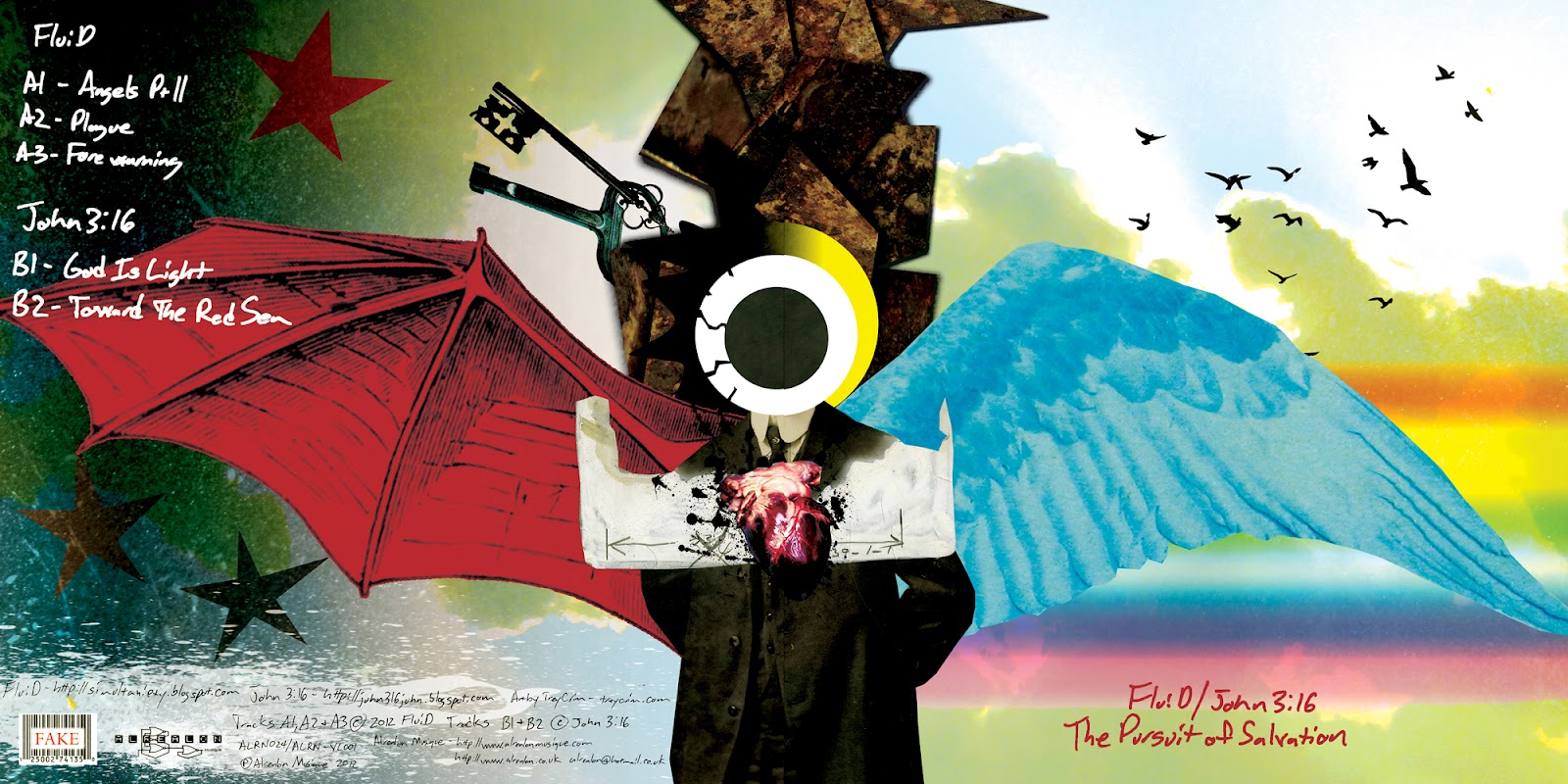
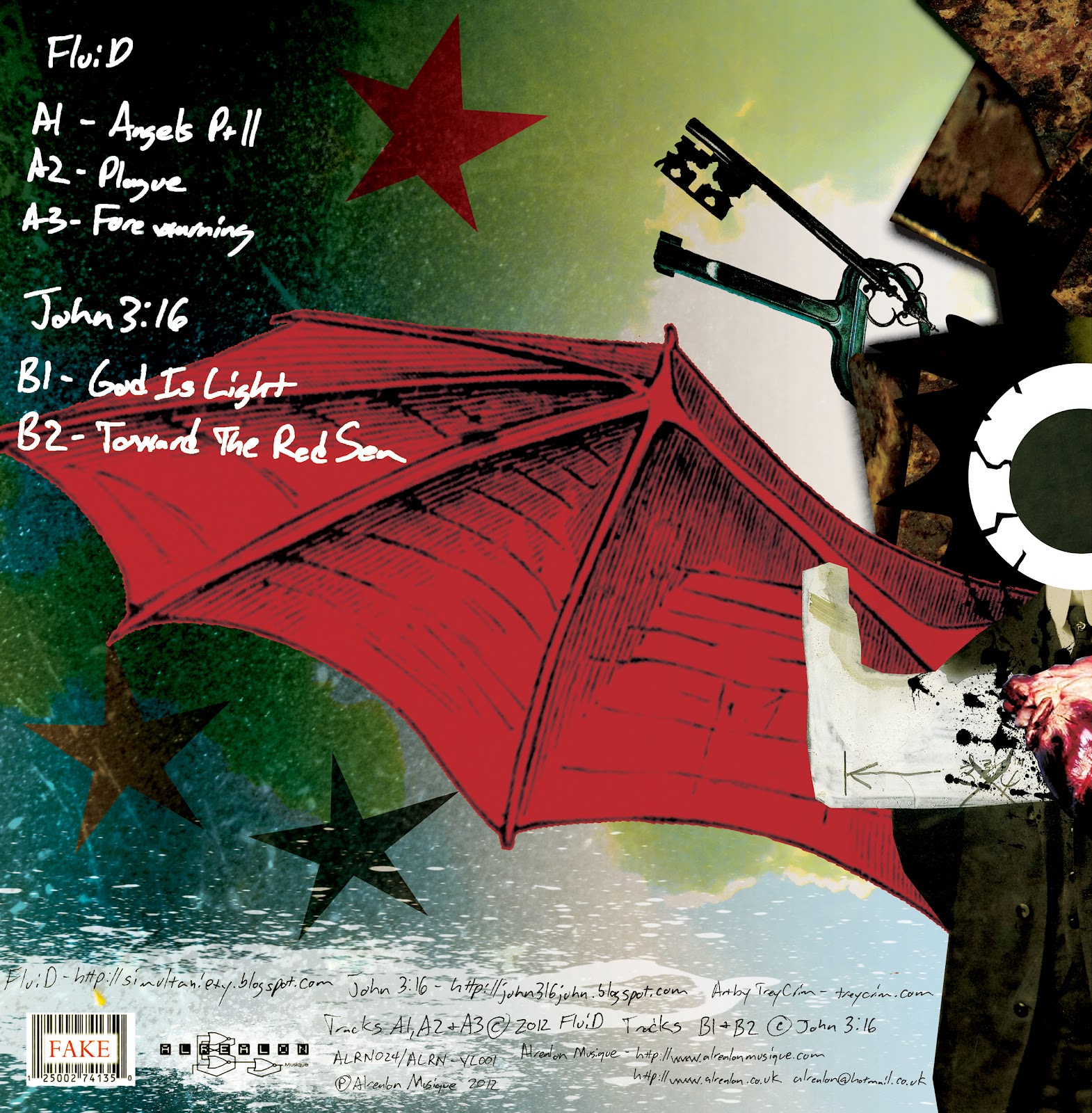
The Pursuit of Salvation is a split record of two very notable electronic musicians, currently surprisingly much under the underground. FluiD is a veteran presence, having released albums since the early 1990s. John 3:16 is a Drone/Industrial/Dark-Wave/Guitar-driven project from Switzerland, active since 2007. FluiD and John 3:16 produce a great split pair, both having similar haunting and enigmatic atmospheres which at times even become soothing. Artwork is also stunning, having only the webrelease I can only imagine how good it would look in my hands as the physical release 12″ Vinyl.

The intro Angels Pt II is particularly impressive – melodic ambient with lots of hooks. A very definition of a catchy intro escalating the atmosphere sky-high. The next two songs develop a more industrial sound but retain the hooks almost as well. Plague could be explained as a bastard-child of melodic dark ambient and industrial, when Forewarning rolls with a massive beat and vague soundclips, which provide more music than voice.

John 3:16 relies mostly on ambient touch similar to Angels pt II. Inside the two tracks there is a lot of variation and surprises. Compared to his earlier release Sinner’s Prayer which I described as “psychedelic gospel ambient” the two songs in The Pursuit of Salvation are even more ambient, melodics being less straighforward. God of Light fills up the continuum by progressing from rich soundscaping ambient to a very FluiD like industrial beat in the end. Toward The Red Sea evokes beautifully corrupted images of a deserted town with wind blowing through and deteriorated objects rattling in the wind to the sound of a distant gloomy church choir.

I can easily imagine both artists progressing to reach more vast audiences if they keep up the quality of their releases this high. The vast industrial and ambient soundscapes are truly thrilling to listen and most of all flow greatly together to form a compact release.

I do not know if Toward The Red Sea is an Isis reference, but having the Isis lyrics in memory I couldn’t help but noting how the last line of Isis’s – Red Sea quite suit the overall atmosphere of The Pursuit of Salvation.

The ocean spreads beneath the skin

Fluid fills blackened lungs

Tar seeps across the eyes

Away in the sea of red

– Isis – Red Sea (1999)


Overall Score: 8+

Alex Tiuniaev – Treedreams

b20efb6d96194ad1b2d50f56aaf6401b.jpg
Surprisingly grand for a wee EP

Ever since I’ve been a kid I’ve been exposed to sequencer, synthesizer and ambient music from the likes of Klaus Schulze, Mike Oldfield, Jean-Michel Jarre etc. Even though they are undoubtedly geniuses, revolutinees of the music field and whatnot, I have never became very close to their music, though I have always kind of liked them. Still, Im sure this exposion has left some mark. Often things you’ve listened as a kid hit you hard later on and I think I finally found my first knack of sequencer-type music on Alex Tiuniaev.

Alex Tiuniaev is an ambient and piano composer from Russia. His EP Treedreams is a small piano driven release consisting of two tracks, both freely downloadable from last.fm. Small does not necessary mean simple, and minimalistic doesn’t mean it doesn’t have a lot of textures. Alex Tiuniaev’s work reminds me subconsciously of Klaus Schulze’s sequencer outputs (which of them, I cannot say). 

Treedreams I consists of a rhythmic melody circling around a rhythmic beat. Treedreams II:n has a similar beat present but it is more piano driven, than sequencer driven.Of these two Treedreams I is the simpler and clearly more memorable having a great catchy melodyline which took a few listens to materialize to its full potential. Treedreams II is a fine closer having more variation and more ambient. However for me Treedreams EP is not complete without a track from Alex Tiuniaev’s newest album Blurred. Another free last.fm download “The Wild Winds Weep” can be cleverly bootlegged to serve as a brilliant intro to Treedreams. The Wild Winds Weep is my latest random find; a full on goosebump effect in the middle of a walk.

While I have only listened Blurred once I can say it does have lots of potential, especially the cinematic “We Were All Fishes Once” caught me unaware on first listen. I cannot fully express why, but somehow Alex Tiuniaev’s music is extremely likable. If Treedreams or any of the synthesizer-artist-household-names-above make any impression to you Treedreams is, and free-to-listen Blurred may very well be, a shimmering find.

Overall score (modified EP): 8-/10

Download Treedreams for free here: Update 2019, unfortunately Treedreams is nearly not available at all, only place where I found it is a straight zip download link here which has some other songs as well: http://archive.org/compress/earman000 . Yeah i know it is suspicious, archive.org checks for viruses though. you can also find the link from here: http://relaxedmachinery.com/earthmantra/unreleases.php.

Shuji Morimoto – Mies Kaukaisuudesta

Melancholic folk pop with sympathetic oddness

A Finnish-Japanese (?) bluesy folk rock coalition who released their first self-titled release as a cassette and free download on their bandcamp-site in the beginning of January. Shuji Morimoto is one of the many projects of Päijänne Suurjärvi, others of note being Päijänteen suopalloilijat and Guggenheim-projektz. All three share the same spirit of absudism yet have a clear own facet.

Mies Kaukaisuudesta is something of a mixture of EP and full-length album, consisting of 6 tracks clocking some 25 minutes. The overall atmosphere is very Finnish, but there is an odd heart of far-away-places and absurdism beating under the surface. The compositions are very airy and vocals mostly clear folk rock-vocals, but at times wander to stranger surfaces.

The vocals avoid the biggest pitfalls successfully even if sometimes they dance on the edge of that wire. Not being that balanced and expecte
d, the vocals and lyrics add a lot freshness and could even say danger to the music. Lyrics are particularly nicely crafted, awaking images of a land far beyond but sometimes they do turn naive. Even if the main image is such a cliche as japan, the lyrics avoid the manganisms and animenisms simply putting in an image of a distant and mystical land.

In this type of music the vocals and lyrics are particularly important but the compositions are surprisingly catchy and thought evoking as well. “Mies kaukaisuudesta” with a superbly catchy chorus and “Nousevan Auringon Maa” both have a lot of groove and swing under a relatively simple surface. After multiple listens it becomes clear that the record indeed has a lot of class under a simple surface. Distorted guitars, synthesizers, clean electric guitars and acoustic guitars take their turns and just when the track asks for it, they provide classy lead-sections bringing the whole matter to the next level.

The next three tracks: “Planeetta Punainen”, “I don’t know anything about Japan” and “Radiation is not good for your health” slow down the tempo and atmosphere from near-ballad to clear ballad. Surprisingly, in the midst the language also changes from Finnish to English and Shuji Morimoto does it effortlessly keeping the atmosphere intact. And how about saving the best melody for last? Gojira’s stylish jam of a steady melodic beat and guitar leads closes up the album.

Is it really a Japanese-Finnish folk rock coalition? Or is it just one man and a made up figure, which even has a facebook page? Here I am suspecting a persons existence but guess what, I do not want to know. Not just yet. This type of mystery is bound to make a project seem somehow more secret and mystic adding its value. In short, I cannot get enough of Shuji Morimoto and Mies Kaukaisuudesta has been spinning regularly on my evening-chilling playlist for multiple months. Extremely recommended.

Download the release for free from their Bandcamp site:

http://shujimorimoto.bandcamp.com/album/mies-kaukaisuudesta